
Tech note: Building a knowledge space on the CASE standard
In 2023, Wicked Storm took on the first-year contract development of the Ministry of Trade, Industry and Energy project “Developing AI for process-based assessment (learning diagnosis) for personalized education” and built a knowledge space on the CASE standard. The work connected the curriculum’s achievement standards and concepts in a standard structure, creating a framework that links assessment and learning.
Why a knowledge space is needed
Process-based assessment diagnoses a learner’s state by looking at how learning unfolds, not at a single final score. To do that, we first need to know which achievement standard and which concept in the curriculum a learner’s activity relates to. A knowledge space is the structure that holds these connections: it organizes the relationships between achievement standards and concepts into a map that diagnosis and recommendation can refer to.
Expressing it in CASE
CASE (Competencies and Academic Standards Exchange) is 1EdTech’s global standard for exchanging curricula, achievement standards, and competencies digitally. Under a single curriculum document (CFDocument), CASE places individual items (CFItem) such as achievement standards or concepts, and records the relationships between items (CFAssociation) using defined association types such as ‘is a child of a parent item’ (isChildOf) and ‘comes before in sequence’ (precedes). Expressing a knowledge space in CASE keeps it from being tied to a specific system, so the curriculum structure can be exchanged with other systems that follow the same standard.
A structure that carries into our products
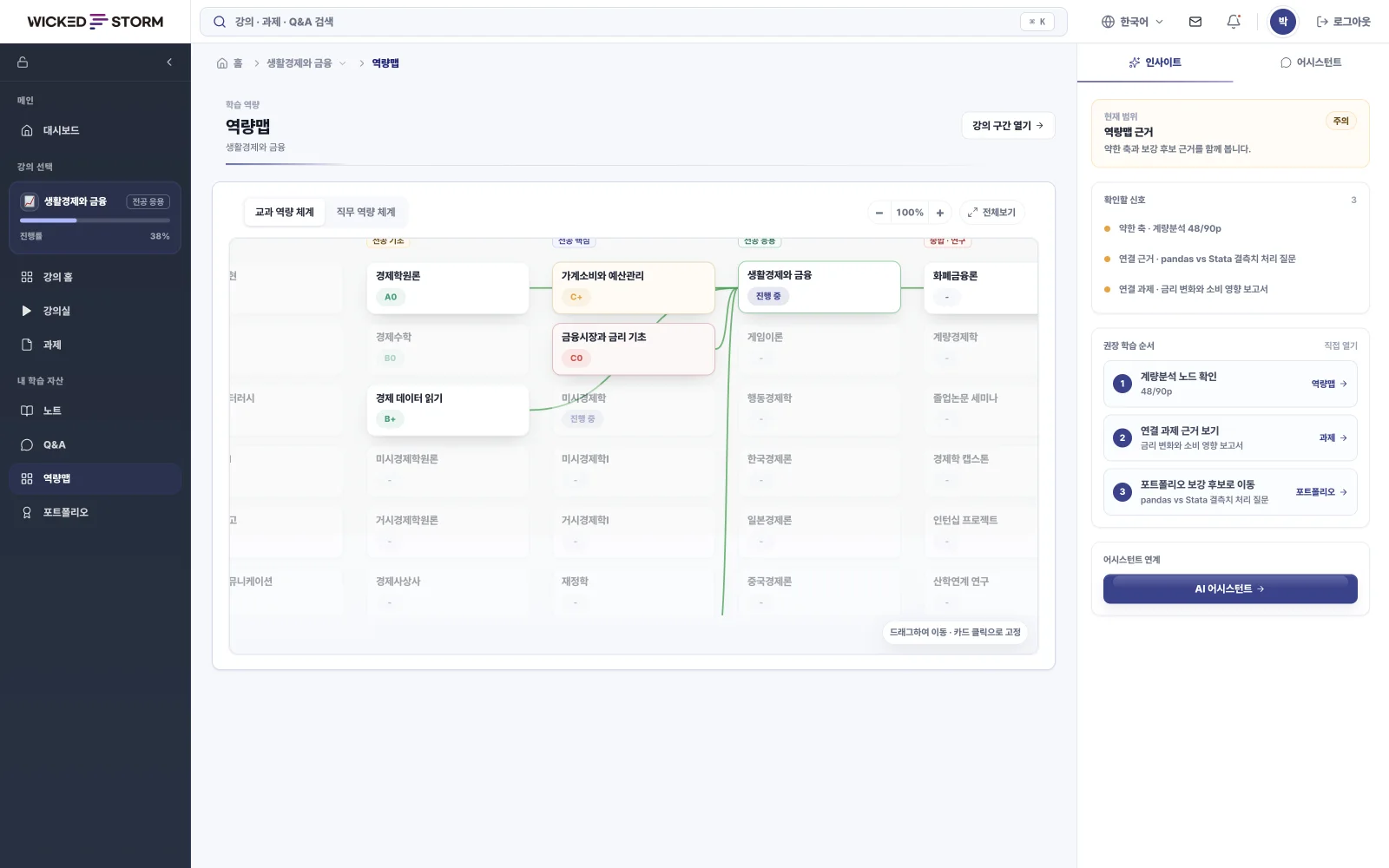
Handling curricula in the CASE structure carries over into Wicked Storm’s products. Lecognizer stores learning activity data according to curriculum frameworks based on 1EdTech CASE, together with the context of the relevant item, and the LearnHubble AI Competency Map shows how prerequisite, current, and follow-up lectures and competencies linked by CASE relate to one another. When a current lecture feels difficult, learners can follow the linked lectures and competencies to find for themselves what they missed.
We will share how we modeled the knowledge space and the choices we made during design in upcoming tech notes.